Stiri

Archive for December, 2025

Romania CO2 Emissions: A New Climate Horizon 18 Years After Joining the EU

08/01/2026

In December 1989, Romania freed itself not only from a political regime but also from an economy based on heavy, polluting industry, massively reliant on coal and oil. For decades, factories and thermal power plants operated without environmental regulations, and CO₂ emissions were almost a byproduct of development. In the early 1990s, each Romanian generated over 9 tonnes of carbon dioxide annually, in an energy landscape dominated by pollution and inefficiency.

Today, after 18 years as a member of the European Union, Romania has one of the lowest per capita emissions in the EU – around 3.7 tonnes of CO₂ per capita in 2023 as reported by the World Bank. This is a major decline, reflecting a profound transition that did not happen overnight but step by step, through economic, technological, and political changes. Official data shows that Romania’s total emissions have dropped by over 75% compared to 1990, reaching approximately 105 million tonnes CO₂ equivalent today, according to “EU Climate Action – Romania Fact-sheet”, 2022.

This reduction came from multiple directions. In the first years after the Revolution, the shutdown of energy-intensive plants in Hunedoara, Galați, Slatina, and Râmnicu Vâlcea led to economic decline, but also to a sudden drop in emissions. Some of these reductions were collateral effects of economic restructuring and massive population migration. Later, especially after joining the EU, Romania began adopting climate policies, based on regulations, financial incentives, and green investments.


Joining the EU Emissions Trading Scheme (ETS) in 2007 was a turning point. Large power plants and industrial facilities were required to pay for pollution, and this market mechanism began to have concrete effects. In parallel, new green energy capacities were deployed: wind farms in Dobrogea, solar projects in the south, and hydro power upgrades. Nuclear energy remained a stable anchor through the Cernavodă plant, and the share of renewable energy has consistently exceeded 20% in recent years.

EU funding has played a decisive role. Over 40% of the National Recovery and Resilience Plan (PNRR) investments are directed toward climate projects, while cohesion funds supported hundreds of projects for energy efficiency and sustainable infrastructure in cities both large and small. From thermal insulation of buildings to the expansion of electric transport, Romania has made clear, albeit uneven, progress toward climate modernization.

However, challenges remain. The transport sector still accounts for a significant share of domestic emissions, and in agriculture, GHG reduction measures are still fragmented. Public administration, especially at the local level, lacks the full capacity to track, report, and regulate emissions in a coherent way. There are major regional disparities, and climate data systems are still underdeveloped.

Romania has set ambitious targets in its official strategies: net emission reduction of 85% by 2030 and climate neutrality by 2050, according to the updated “Integrated National Energy and Climate Change Plan (NECP)”, 2024. These objectives align with the European Green Deal, but require full mobilization: decarbonizing the energy system, electrifying transport, increasing carbon capture in forests and soils, and adapting agriculture to new climate realities.

What is worth highlighting, however, is that these climate transformations have not led to economic stagnation – on the contrary. In parallel with a sharp reduction in emissions, Romania’s GDP has increased more than fivefold since the year 2000. During the same period, millions of people rose out of poverty, cities were modernized, and the economy opened up to green investment, digitization, and technology. Romania has proven that ecological transition does not mean slowing down, but can go hand in hand with economic and social development.

Today, Romania offers a rare example in the European Union: a country that has drastically reduced emissions, lowered its carbon footprint per capita, yet at the same time managed to achieve economic growth and improve the living standard of its population. It is a lesson in balance, in the ability to turn constraint into opportunity, and in how an Eastern European country can become a credible player in the new European climate landscape.

Posted in: Uncategorized

Leave a Comment (0) →
Carbon Expert and Greentech – Global recognition on the voluntary carbon market

29/12/2025

The voluntary carbon market is the space where CO₂ emissions turn into opportunities. Companies that commit to sustainability goals invest in projects that reduce emissions through the purchase of carbon credits. Voluntary carbon credits are certificates that show that one ton of carbon dioxide (CO₂) has been reduced or removed from the atmosphere through an internationally verified project. In this way, part of the unavoidable emissions are balanced by investments in projects that have a real effect on the environment and communities.

In recent years, this market has become a global mechanism through which both large and small companies, from Google to local firms, manage to achieve their climate targets. For some, it means reputation and social responsibility, for others it means innovation or marketing. For us, at Carbon Expert, it is the field in which we have been active for over 15 years and in which we have developed and promoted projects with measurable impact, both in Romania and abroad.

Within this framework, Carbon Expert has recently received double international recognition. The company was awarded in 2025 as the “Best Project Developer Public Health”, and was voted the second-best consultancy firm on the voluntary carbon market worldwide. Moreover, the project advised by our team, Greentech Plastic Recycling, part of Green Group, won the award for the “Best Individual Carbon Offset Project” in the world.

The awards can be seen here.

“Greentech’s plastic credits through recycling,” implemented in Buzău, is the first Romanian plastic recycling project certified on the voluntary market. Every year, Greentech avoids over 45,000 tons of CO₂ emissions. To better understand this volume: it represents the equivalent of more than two million mature trees absorbing the same amount of emissions in a year. The impact is not limited only to emission reductions, but is also reflected in local jobs, technological investments, and the development of the circular economy in Romania.

More information about the project can be found here: Greentech – Carbon Expert. Official details are also available in the Gold Standard registry.

The recognitions obtained confirm that Romania can be an important player on the global voluntary market. Through Carbon Expert, projects such as Greentech become visible internationally and demonstrate that the transition to climate neutrality can start locally, with concrete and verifiable results. This visibility opens opportunities not only for the business environment but also for the entire Romanian economy: it attracts investments, creates green jobs, stimulates technological innovation, and positions Romania as an example of best practices worldwide.

The fact that a Romanian project has been designated the best carbon offset project in the world shows that local expertise and initiatives can stand alongside the most important global projects. It is an important message for Romanian companies, which can leverage the voluntary market not only to achieve their climate objectives but also to build a competitive advantage and a strong image of responsibility.

Carbon Expert Plans for the Future

Carbon Expert also aims to develop new types of projects, including methane emission reduction projects in agriculture (valorizing animal waste through composting) or biogas projects, together with key players in these markets: Kohshin Engineering Co., Kohshin Europe, Genesis Biotech. Although it intends to prepare these projects for carbon credit purchases under a “pre-issuance” regime (before the issuance of certificates) to genuinely support the project’s initial investment, this is not simple in a market that is still developing. Another example of a successful, high-quality project that has obtained carbon credits with the Gold Standard certification body is located right in Bucharest: the AS Metal Aluminum Recycling Project. Details about Carbon Expert’s project portfolio in Romania can be found here: Carbon Offset Projects.

About the Voluntary Carbon Market

The voluntary carbon market (VCM) is still relatively small compared to regulated markets, but it is growing and has significant prospects. In 2024, the value of the global voluntary carbon credit market was estimated at approximately USD 4.04 billion. It is estimated that by 2030 the market could reach USD 23.99 billion, with a compound annual growth rate of about 35.1% between 2025 and 2030. The future development of this market depends greatly on factors such as national, European, and international regulations, international crediting standards, project integrity, and corporate sustainability commitments.

The importance of the voluntary carbon market is being discussed more and more at the global level. The publication Environmental Finance shows, in a recent analysis, that financial institutions will have a decisive role in expanding this market and in increasing demand for high-quality credits: Will financial institutions pile in to the voluntary carbon market?. Casiana Fometescu, founder and CEO of Carbon Expert, believes that “greater awareness among companies of the value of recycled materials and the real benefits they bring to the circular economy in Europe would be of real help in leveraging carbon credits.”

We thank all our collaborators, the Carbon Expert team, and above all, God, for this achievement!

Posted in: Uncategorized

Leave a Comment (0) →

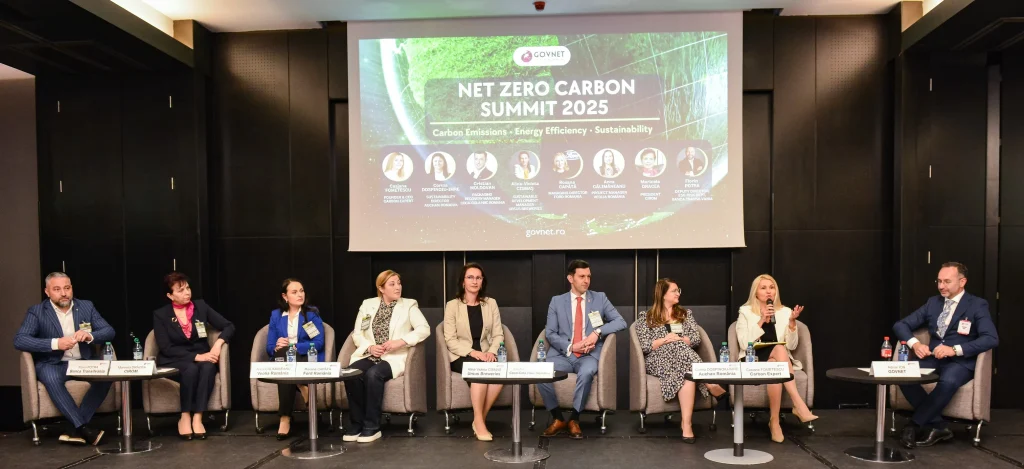
Carbon Expert at Net Zero Summit 2025

 06/11/2025

Net Zero Summit

We were glad to have our Founder and CEO, Casiana Fometescu, speak at the fourth edition of the Net Zero Carbon Summit, held on April 29, 2025, at the Sheraton Hotel in Bucharest. The event, organized by GOVNET Romania, brought together industry leaders, sustainability experts, and company representatives who are committed to building a more sustainable future.

The main theme of the summit was accelerating Romania’s transition to a Net Zero economy, with a focus on real solutions and business-driven examples.

Casiana spoke about carbon credits and the connection between voluntary and compliance markets. She explained the differences between the two and how they can be combined to work better together. She pointed out the challenges companies face, such as emission reporting and finding real, reliable ways to offset emissions. She also stressed the need for clear rules and proper verification, whether credits are used voluntarily or for legal compliance.

Her presentation sparked interest through real examples from projects developed by Carbon Expert in recent years, both in Romania and abroad — in areas like recycling, composting, and capturing greenhouse gases. She highlighted how the voluntary carbon market can help speed up emission reductions, especially now, as more companies commit to ambitious climate targets and need effective tools to meet them.

The summit featured a wide range of speakers, including representatives from Banca Transilvania, PwC, ING Bank, Coca-Cola HBC , Ford, Auchan, and Ursus Breweries. Topics included ESG integration in investment decisions, supply chain decarbonization, energy efficiency, and sustainable urban planning. A key takeaway was that tools like carbon credits are becoming essential for any company that wants to stay relevant and competitive in the long run. We intend to convey and support the conclusion of this Summit at future meetings that we will organize with representatives of the European Commission.

We’re proud to be part of the national and European dialogue on Net Zero and to help shape a low-emission, more sustainable economy through our work.

We’re not just talking about the future. We’re building it, step by step, project by project

Posted in: Uncategorized

Leave a Comment (0) →
CO2 Calculator